DAY 22 - Saturday 18th July 2009 - To Phi Phi!

It was time to move on. Our period in Patong had come to an end, Nick’s lasting eight weeks, mine lasting barely three. Nick had become bored and tired with Patong: its polluted and dirty streets, the countless salesmen and taxi boys desperately peddling their wares, the hordes of tourists on every street, and, the source of the most anguish, our dull and inadequate accommodation. My feelings were similar, but I was eager to explore another part of Thailand. Hence our decision to pack up and disappear, waving goodbye to Phuket Island altogether, leaving to spend a few days on Phi Phi Island, famous for its serenity and beauty.

So long Patong!

We awoke desperately early in the morning, having retrieved all of the possessions which seemed to have escaped into various nooks and crannies around the room throughout the duration of our stay and crammed our cases full. I stumbled around, still saturated with the whiskey from the Sunrise Farewell the night before, which I later discovered, to my horror, that it was 80% alcohol content. This explained a lot.


After an eternity of sitting on the hard, bottom-numbing roadside curb, surrounded by luggage, the minibus finally arrived half an hour later due to a mix up with the street names, and we were driven to the harbour, once again Chalong Bay, and boarded the enormous ferry.


One hour and twenty minutes afterwards, semi-frozen and shivering from the glacial onboard air-conditioning, we gratefully welcomed the thawing heat and lugged our luggage up the boarding plank and onto the pier. Phi Phi Don greeted us, the larger of two islands within the Phi Phi archipelago. However, the journey had not ended yet; Phi Phi has no proper roads, with pockets of cleared areas separated by dense forest. Unless we were struck by an irrational desire to either swim or turn our cases into rafts and use Nick’s scuba fins as paddles, the only way to reach our hotel resort was to book a long-tailed boat, which would take us around the island. Not feeling particularly up to more rowing, and agreeing that a boat was probably the most sensible option, we were soon on the way, zipping past constant beaches, decaying wooden huts and other distant islands.


The small boat docked as close as possible to the island before a large, odd amphibious car-boat with caterpillar tracks came tearing through the shallow water and expected us to leap aboard. We obliged, and before you could say something that would take approximately 5 minutes to say, we were dismounting the boat-car-caterpillar on a sandy, white beach.


A smiling Thai lady greeted and smiled politely and bowed, showing us to a covered but open-aired reception area. Nick and I collapsed into chairs, groaning and sighing with relief. We had noticed it immediately: the silence. There was no noise or commotion, besides other visitors conversing quietly, the sea gently lapping the beach, and the songs of distant birds. Things couldn’t get any better, we agreed, before being immediately proven wrong by the lady appearing, bearing a pair of ice-cold coconut drinks.


The reception area


Some scribbling and signing official forms later, a gentleman heaved our luggage into a rickshaw and led us down a few winding paths, passing lofty coconut trees, green shrubs and numerous wooden huts on stilts.


Down the winding path...


Upon arriving at a specific hut, clearly our room, the man showed us around the jaw-droppingly beautiful, painstakingly prepared room, which was to be our home for the next six days. There were flowers everywhere: laid on the beds, thrown on the floor, in the toilet… (Which I forgot about until after flushing, watching in panic as it zoomed down the loo.)

Our "room"


Flowers everywhere!


The Toilet Flower, pre-flushing


In Patong, we had been forced to use our own umbrellas during rain, buy water and, worst of all, purchase our own toilet paper. Compared to Patong, this was heaven. Heaven came disguised as a pair of large umbrellas resting outdoors, four bottles of complimentary water sat on a shelf, and papier toilette, no fewer than two rolls of glorious, wonderful toilet paper, lovingly folded into intricate patterns.

I notice this blog is rather toilet-heavy. My apologies, but look at the paper! Look at it!!


Satisfied and at last at peace, giddy with relief, Nick and I set off to explore the rest of Phi Phi Island Village.

DAY 19 - Wednesday 15th July 2009 - James Bond Island

Packed into a minibus, Nick and I discussed our sincere hopes that the day’s pastimes would provide better entertainment than our time spent with Thailand Safari – and not entertainment of the garish sort. Frankly, if I saw another monkey on a tricycle, I would immediately demand a refund and a ride home.


Our guide, having introduced herself as Oom (honestly), delivered us and the minibus full of French and German tourists to a rubber plantation on mainland Thailand. I controlled my bubbling temper, already exacerbated by the dull, grey sky which had greeted us from dawn. This was already beginning to suspiciously resemble Thailand Safari. The demonstration on how to create a sheet of rubber was eerily similar to the Safari latex display. Oom cheerfully rolled the rubber through a press, explaining the need to squeeze it completely free of moisture before hanging it to dry in the sun for at least two weeks. She casually mentioned how Thai plantation workers tend to refer to the rubber trees as Condom Trees, forcing a scandalised Australian mother to leap forwards and clap her hands over her daughters’ ears.
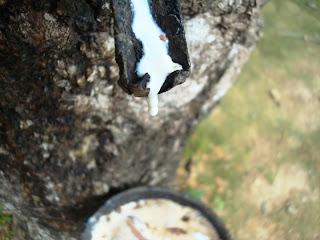

A Condom Tree


The rubber visit had lasted barely ten minutes before we were bundled into the minibus and whizzed off to our next location.


Monkey Cave greeted us, while the eponymous simians leapt around like crazed grasshoppers and coated every available surface with living, breathing fur and disturbingly exposed bottoms. My irritation began to ebb away. Monkey Cave is sacred to the Buddhist Thai populace, as the exclusive burial site of local monks. It is both a shrine and a tourist destination, and the cacophonous mix of yelping Macacque monkeys, waddling tourists and shrieking salesmen and saleswomen. The commotion, however, could not put me off; Monkey Cave was a combination of history…and monkeys. Things couldn’t get any better.


Three hundred years old!


We were ushered into the cave, passing through an enormous stone archway, while the monkeys swarmed around us. The interior of the cavern was enormous, cavernous even, and contained various towering statues, all painted stone and all at least three hundred years old. I sighed with relief as we passed beneath the shadows of the peeling, cracked and grimacing sculptures – finally, some real Thai history! I frequently shuffled up to Oom to ask questions, learning that the idols guard the cremated ashes of Buddhist monks, and that the presence of the monkeys is holy to them. The air was heavy with the lingering presence of the past, and the weight of the silence and solidarity pressed upon our ears. I couldn’t resist buying a tiny, carved sandstone Buddha which Nick eyed suspiciously before snorting with disbelief when I told him the price.


My own little Buddha


Pushed for time, I rushed up to an elderly lady and bought some nuts to feed to the monkeys. I turned to make sure Nick was in the vicinity, camera at the ready; but before I knew it the cackling old woman had crammed my pockets full of the things. I gulped when a fat adult Macacque wobbled up and slowly and cautiously inserted a long-fingered hand into my trouser pouch before methodically clawing out a handful. News appeared to spread quickly. Surrounded by Macacques, I resorted to hurling fistfuls of nuts into the proliferating mob, while attempting to ensure a fair share for some of the smaller and evidently younger animals. This seemed to cause a fight as a growling, much larger specimen swiped at its slighter brothers or sisters, and began stuffing its mouth before howling triumphantly. I spat at the monkey’s feet and turned away in disgust. No, I didn’t really, in fear of incurring some kind of religious sacrilege, but I would have liked to.


I battle the monkey


Discarding the last of the nuts into the now-screeching throng, we once again entered the bus and let ourselves be shepherded to the coast.


Aww, baby monkey!!


The boat appeared to have a monstrous engine strapped to the back, as though somebody had sneaked into a farm and ripped out the internal workings of a tractor. Now enclosed in lifejackets, Nick and I took our seats near the very back of the boat, and worryingly close to the beast machine. I turned to Nick as a man attempted to tug the engine into life. “Do you think it will be too loud to tal-” I began before an eardrum-bursting roar tore through the air, instantly drowning me out. Nick looked relieved for some reason.


On the boat - with the monster engine in the background


It was time for some lunch. My stomach sighed happily before promptly imploding as I realised where we had docked, all of us very wet and very deaf: Pannyi, a floating fisherman’s village. Yes, a fascinating place. An entire community, complete with people, animals and its own economy, permanently lashed to wooden boards and forever floating, never touching dry land. Yes, I was incredibly lucky to be there. But it was a fishermen’s village. Fishermen fish. For fish. So lunch was, logically, to consist entirely of seafood, which I despise eating. I muttered prayers under my breath as we were seated at a beautifully prepared table and sobbed when prawns, rice and fish and shrimp were laid our before us. Mercifully, a measly piece of chicken was proffered in my direction, which I seized ravenously and swallowed whole. Nick contentedly helped himself to the extensive fish dishes.


Pannyi Village


We were unleashed upon the village and given the freedom to roam wherever we wished, providing we didn’t wander into the sea as this may have infringed upon certain insurance procedures. The village itself was very much like a smaller, quieter, and less odious Patong. Although in Patong, the residents tend to venture from their city unlike the inhabitants of this buoyant society, who spend their entire lives at sea and do not once set foot on dry land.


Once again boarding our superpowered vessel, we sped to the entirely stunning rock structure of Ko Tapu, marketed and known colloquially as James Bond Island. Dubbed as such after the 1974 007 film The Man with the Golden Gun was filmed here, it has become one of the most popular and photogenic sites in Thailand the most dramatic and awesome limestone sea rocks in Phangnga Bay. The Thai name translates as nail in the sea, which is certainly a more accurate description than James Bond Island; while not shaped like a womanising, gun-crazed, suit-clad English lunatic, it does stand as a lone pinnacle, towering and resolute, as though it has been hammered forcibly into the middle of the cove and left to stand for evermore.


Ko Tapu (James Bond Island)


Naturally, it provided ample photo opportunities as Nick and I scrambled up and down rock stairways, searching for the best spot. “That should be your Facebook profile image!” soon became the ultimate compliment to the quality of a picture. Before long, we bundled ourselves into the boat and set off for the final leg of our journey.


Irrefutable proof that Nick and I have been to Thailand!


On arrival at an odd sort of stationary floating boat, we were told to line up, keep on our lifejackets and sit in pairs on a succeeding line of dinghy-canoe-things, each controlled by a Thai fellow wielding a double-edged paddle. The last one swung by: Nick hopped in and I teetered on the edge before heavily flopping down, causing the entire vessel to rock. Our man paddled us skilfully across the water, and it became apparent that we were to be given a tour of the bay and its countless tunnels. I shan’t bore you with an entire account of the trip, but we swept under extremely low tunnelled ridges forcing us to lie flat and for me to gradually disappear slowly into my lifejacket like a tortoise, and into mini flooded valleys, enclosed by towering stone walls and lidded with thick tree canopies.


One of the many ridges...


I prepare to lie horizontally


A flooded valley


Through a cavern


Eventually, exhausted and soggy, we found ourselves back on the boat, speeding towards the port where we had begun this voyage. In all, the events of the day had been satisfyingly authentic, providing tradition, zoology, history, and geology. And not a single monkey riding a tricycle in sight.


DAYS 13 & 14 - Thursday 9th and Friday 10th July 2009 - Lions (fish) and leopards (sharks) and wrecks: oh my!

It was only after days of prodding and words of conviction from Nick that I finally relented and decided to buy another two days of scuba diving training; in this case, an Advanced Open Water Course, which would allow submersion of 30 metres – just 10 from the absolute maximum allowed in recreational scuba diving (which is 40, in case your maths skills are as terrible as mine).

My pre-dive briefing with Adam, involving much nodding and taking notes


Thus we once again found ourselves on the dive boat, speeding towards Racha Yai. I had by now become certain than I was somewhat blessed; the weather had miraculously cleared, despite preceding days of rain and cloud, and the sun was promising a scorcher. My British penchant to moan about the climate was in shreds.


The ship's cook washing vegetables for lunch


The first dive of the day would be different to my previous outings as Nick was now armed with a digital camera, securely enclosed in a waterproof case. After some short tests which included me hovering in water, legs crossed, demonstrating buoyancy control, Adam led us on a fun dive, over and through Racha Yai’s coral reefs.


I attempt buoyancy control - with limited success


We were delighted to discover an enormous moray eel, gaping out of its captured awning cavern and resolutely blind to our presence as Nick happily snapped away.


Adam and I with the moray eel


The moray eel - the camera flash brings out the hidden underwater colours!


The subsequent dive, however, did not succeed with quite so much light joviality. The skill I was supposed to demonstrate was underwater navigation. As it included much computation and, God forbid, numbers, I was naturally hopeless. My repeated inaccurate calculations and flapping in the wrong direction, casting occasional glances at my compass, only to be buffeted by the strong current into swimming even further off course were taking a toll: Adam’s growing frustration was becoming evident by his increasingly louder and more disgruntled underwater grumbling, and Nick later admitted to consuming far more air than he is used to after continual attempts to catch me and save me from crashing headlong into a reef. Upon broaching the nitrogen limit, we ascended, having failed to complete the task in time. Aware that the practically wasted dive had been nothing less an unmitigated disaster, my journey back to Phuket included much dejected silence and shameful head-hanging.


Nick has no such troubles with navigation


My spirits were reignited the next day, as it would include my first ever 30-metre dive – and what a dive! It would be a visit to none other than the King Cruiser, a 48-metre ferry wreck. There are three conflicting theories to the origin of the King Cruiser wreck, as the ferry was allegedly in perfect condition when it went down on a flat, calm day, in the middle of the ocean. Firstly, that the captain had been drinking a little bit too much prior to the commercial journey to Phi Phi island. Next, that the accident was the result of an elaborate insurance scam. Lastly, that the major dive schools on Phuket had each chipped in a few thousand baht, a successful bribe directed towards the captain so they could ensure Phuket’s first wreck: a huge draw and big money-spinner amongst diving enthusiasts. (The latter is popularly believed to be the most likely, and I am inclined to agree.)


Changing the cannister between dives - a few seconds later, it exploded (not really)


The ship itself is extraordinary. In the 12 years since it was lost from the surface, the underwater world has quickly claimed it for itself. Coral has spread over its great hull, infecting the interior and attracting millions of fish and sea creatures of all shapes and sizes. Unfortunately the camera was left safely onboard throughout this dive, as Adam strongly advised constant wariness, not because of danger from animals, but because the rusted steel and numerous sharp outcroppings could damage scuba equipment far more easily than anything not fabricated by humans. I kept this in mind as I swam cautiously through a corroded open doorway, narrowly avoiding a drifting lion fish in the process.

King Cruiser had been interesting, but the next dive would include a sighting of the most beautiful creature yet seen by my inexperienced underwater eyes. We were diving at the aptly-named Shark Point, home to dozens of leopard sharks. Virtually harmless to humans, this particular shark, at least two metres long, was lying casually in the sand. Adam inched his way towards it while I followed close behind until we were but an arm’s length away from its head. We had followed Adam’s earlier instructions; approach only from the front, otherwise it will flee instantly. A few seconds passed as a cleaner fish wriggled up its back and the animal idly opened and closed its mouth. I made a sudden, inadvertent movement and the shark instantly whipped around and lithely propelled itself into the murky distance, beating its powerful tail just once or twice.


Before a giant stride entry - Nick was determined to capture my swimming shorts on camera


Adjusting my mask


The third and final dive of the day was also the shallowest, taking place along the rocky and coral-encrusted walls of Koh Doc Mai. Adam had thoughtfully brought along his own camera and handed it to Nick, who snapped a few photos before handing it to me. Driven by the desire to capture the underwater world in photographic form, I went snap-happy photographed anything and everything, often of mundane pieces of coral, or of lonely fish. I began to form an appreciation for underwater photographers; the fish in particular frequently darted from the frame, leaving a pointless photograph of a frustratingly bare patch of rock. My patience began to fray; I suppressed the urge to grab a fish and tie it to a rock with a piece of seaweed.


Prior to an ascent - look, it's difficult to pose underwater.


This dive was memorable for three other events; a brief encounter with a pitch-black undersea cave, a quick glace at a solitary seahorse, and my repeated collisions with other divers followed by my frantic gesticulated apologies. One such impact with a Japanese fellow resulted in me shouting “sorry!”, only remembering too late that speaking underwater is impossible. My attempt at an apology yielded a stream of bubbles and sounded more akin to “murrblurb”. I hoped desperately that he didn’t assume an obscene insult, although the likelihood of such is increased by his replying with the flicking of a middle finger.


Koh Doc Mai

While Adam, Nick and I awaited the boat on the surface of the sea, rising and falling with the surging waves, I contemplated my scuba journey so far and realised that I could hardly wait for another opportunity to launch myself into the depths of the earth’s ocean.

Nick and I